
Surgical Solutions for Tooth Loss
Reconstructive Surgery When Tooth Loss Has Occurred
When natural teeth are lost – either as a result of injury, advanced periodontal disease or other medical or lifestyle conditions – the impact to the surrounding bone and tissue will be progressively detrimental to the patient’s oral health. If left untreated, it often becomes impossible for the patient to restore their teeth through dental implant placement when the bone and/or tissue has been compromised.
The Pennsylvania Center for Dental Implants and Periodontics has treated thousands of patients with highly advanced procedures that can help restore the area where tooth loss has occurred and prepare the patient for a successful dental implant procedure.
Bone Grafting (Ridge Reconstructive Surgery/Ridge Preservation)
When tooth loss has already occurred, the associated jawbone will often sink in and shrink over a period of time. This often creates a condition where the poor quality and quantity of bone make the patient ineligible for the placement of dental implants.
However, we now have the ability to grow bone where needed and prevent future bone loss as well, using advanced biomedical materials such as GEM-21 ®mixed with bone grafting material with Titanium mesh and PRGF (Plasma Rich in Growth Factors). This gives us the opportunity to place implants of proper length and width, and it also gives us a chance to more effectively restore esthetic appearance and functionality.
Hard Tissue Reconstruction/Ridge Augmentation (to correct gum indentation)
The loss of one or more teeth can cause an indentation (concavity) in your gums and your jawbone. Frequently, this looks unnatural and detracts from the appearance of your smile. It can also preclude the ability to place a dental implant due to a lack of bone. Our practice has a long, successful history using a procedure called ridge augmentation to recapture the natural contour of your gums and jaw. This gives you the appearance of a new tooth that is natural-looking, easy to clean, and beautiful, giving you a brilliant and symmetrical smile.
Crown Lengthening (Pre-Prosthetic Surgery)
When a tooth is broken near or below the gum line, it cannot support a crown or other prosthetic materials. Rather than pulling the tooth and having to replace it with a dental implant, we can frequently salvage it using a crown lengthening technique.
Crown lengthening is a surgical procedure that can create more tooth structure by removing soft tissue (gum) and hard tissue (bone) from the patient’s adjacent teeth (one tooth in front and one tooth behind the damaged tooth). This then becomes a three-tooth procedure, and its goal is providing adequate tooth structure to anchor the new crown.
If the tooth cannot be saved, other options — such as a dental implant — will then be discussed. An option in certain situations of single-rooted teeth is orthodontic extrusion of the tooth.
Sinus Augmentation (or Sinus Lift) to support Successful Implant Placement in the Upper Back Jaw
The upper back jaw has traditionally been one of the most difficult areas in which to successfully place dental implants due to insufficient bone quantity and quality (the upper jaw naturally has less bone density than the lower jaw) and the close proximity to the sinus. Sinus augmentation (also called sinus lift surgery) can help correct this problem by raising the sinus floor and developing bone for the placement of dental implants.
Several techniques can be used to raise the sinus and allow for new bone to form. In one common technique, an incision is made to expose the bone. Then a small circle is cut into the bone. This bony piece is lifted into the sinus cavity, much like a trap door, and the space underneath is filled with bone graft material mixed with your own PRGF (Plasma Rich in Growth Factors).
Finally, the incision is closed and healing is allowed to take place. Depending on your individual needs, the bone usually will be allowed to develop for about four to 9 months before implants can be placed. After the implants are placed, an additional healing period is required. In some cases, the implant can be placed at the same time the sinus is augmented when there is adequate available bone to begin with. This procedure is called a site-specific sinus lift (osteotome) and reduces the healing time significantly.
Undergoing sinus lift surgery has been shown to greatly increase your chances for successful implants that can last for years to come. Most patients experience minimal discomfort during this procedure, as well as after.
Am I a Candidate for Tooth Loss Treatment?
Reconstructive surgery prepares the area where a tooth was lost so it can hold a dental implant. You may be a good fit if:
You've lost a tooth and the bone in that spot has shrunk.
You've been told you don't have enough bone for an implant.
You need an implant in the upper back jaw, where a sinus lift may be needed.
There's a visible dent in your gum and jaw where a tooth used to be.
A tooth is broken near or below the gum line, and you'd like to save it.
Your periodontist reviews your X-rays at your consultation and tells you which procedure, if any, your implant needs.
Frequently Asked Questions
Do I need a bone graft before getting a dental implant?
Only if the bone where the tooth was lost has shrunk too much to hold an implant of the right length and width. After a tooth is lost, the jawbone in that spot tends to sink and narrow over time, so a long-standing gap is more likely to need grafting. Your periodontist measures the bone on your X-rays at your consultation and tells you whether a graft is needed before anything is scheduled.
What's the difference between a bone graft and a sinus lift?
A sinus lift is a type of bone graft for the upper back jaw. That area naturally has less dense bone and sits just below the sinus, so there is often too little height to hold an implant. We raise the sinus floor and fill the space beneath it with graft material mixed with PRGF, prepared from your own plasma. Other bone grafts rebuild the ridge in the rest of the jaw.
How long after a bone graft can I get my implant?
After a sinus lift, the new bone usually develops for four to nine months before the implant goes in, followed by a second healing period once it is placed. When enough bone is already present, a site-specific sinus lift lets us place the implant during the same procedure and shortens the overall timeline. Your periodontist gives you a timeline for your case at your consultation.
What is recovery like after a sinus lift?
Most patients have minimal discomfort, and the aftercare is mainly about protecting the graft. For two weeks, you'll use a saline nasal spray and avoid blowing your nose. Bending over and holding in a sneeze are also off limits during that time. Light nosebleeds are normal, and a few small bone particles in your mouth in the morning are expected. Our pre and post-op instructions cover the full routine.
How much does bone grafting cost?
Your fee depends on what your case needs, so it is set after your periodontist has examined you and reviewed your X-rays. Your treatment coordinator then gives you a one-page summary of your options and fees to take home before anything is scheduled. We are out of network with all dental insurance plans, but we submit the claim for you. See our financial information for payment options.

Reconstructive Procedures
Reconstructive Care
Surgical Solutions for Bone/Gum Loss

Get Started Today
Top-Rated Periodontics & Implants
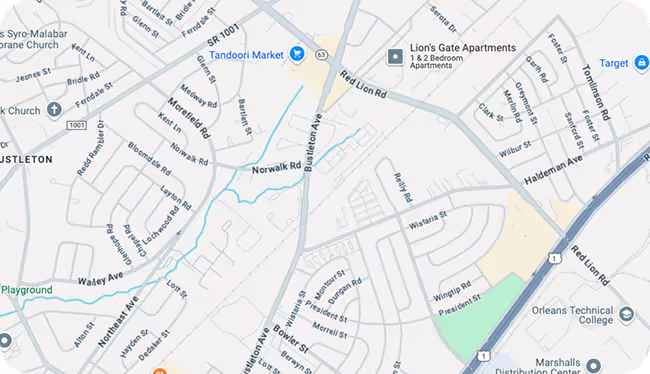
NE Philadelphia Location
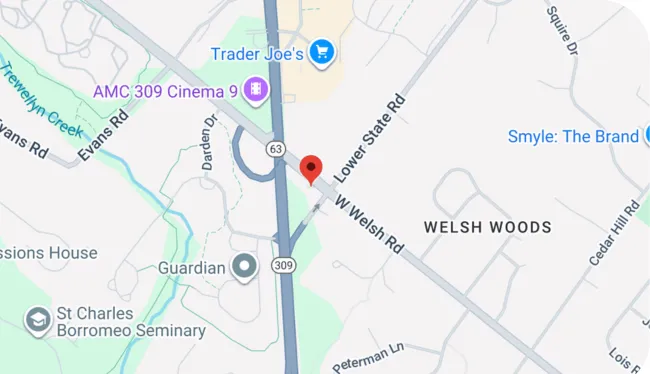
Lower Gwynedd Location
Lower Gwynedd Township, PA 19002